A Universe of Art Born from E-Waste
Most galleries are built from materials chosen for their beauty. This one is built from materials chosen for their second life. Every piece here began as a discarded circuit board — a motherboard, a controller card, a decommissioned industrial panel — and was transformed through documented community technique into something worth displaying on a wall. The range is wider than most visitors expect: small jewellery-scale pieces sit alongside large multi-panel installations, and the aesthetic spans geometric precision, organic composition, and everything between.
- Every piece sourced from salvaged boards
- Open submissions from any skill level
- Curated with consistent review standards
- Works spanning all scales and formats
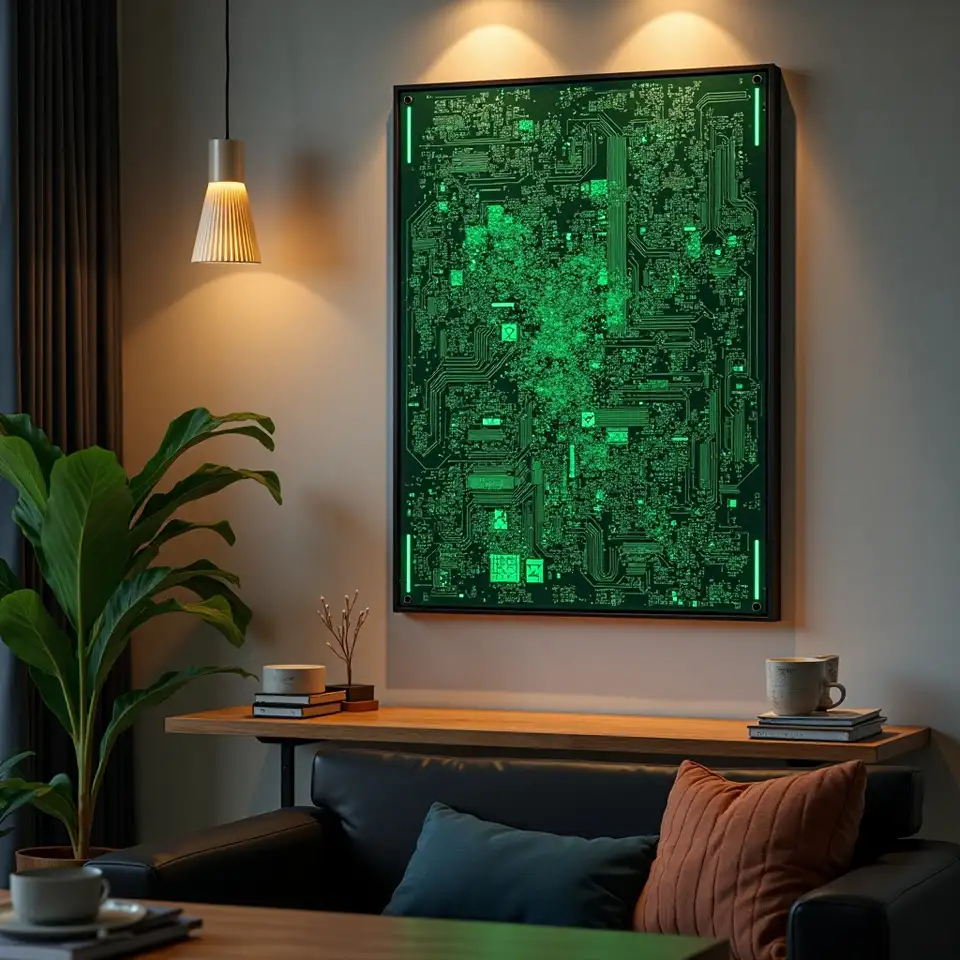
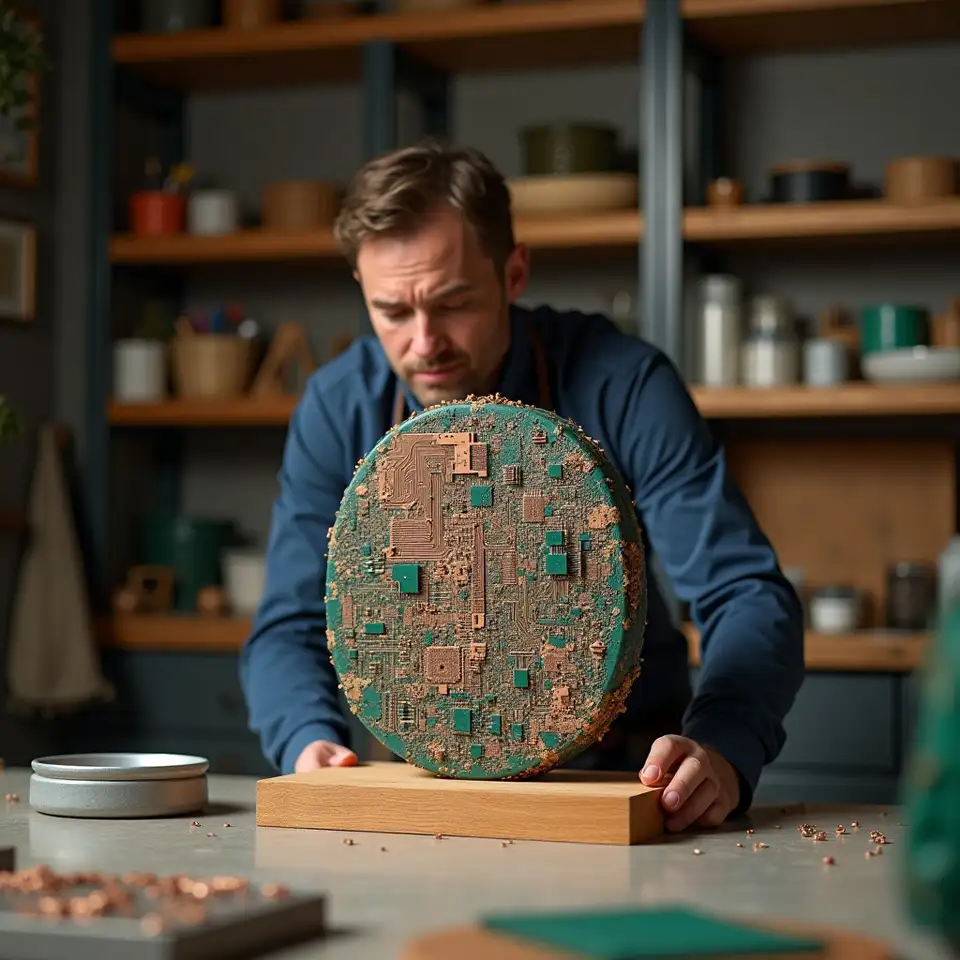
Community Gallery of Circuit Board Art
Every submission here has passed the same curation review regardless of the
contributor's experience level. Pieces are accepted based on documented sourcing and
technique, not on reputation. The gallery is organised by category — wall art,
jewellery, sculptures, clocks, and mixed-media installations — and sourcing notes are
displayed alongside each piece where the contributor has provided them. Scroll through
to see how differently members interpret the same raw material.
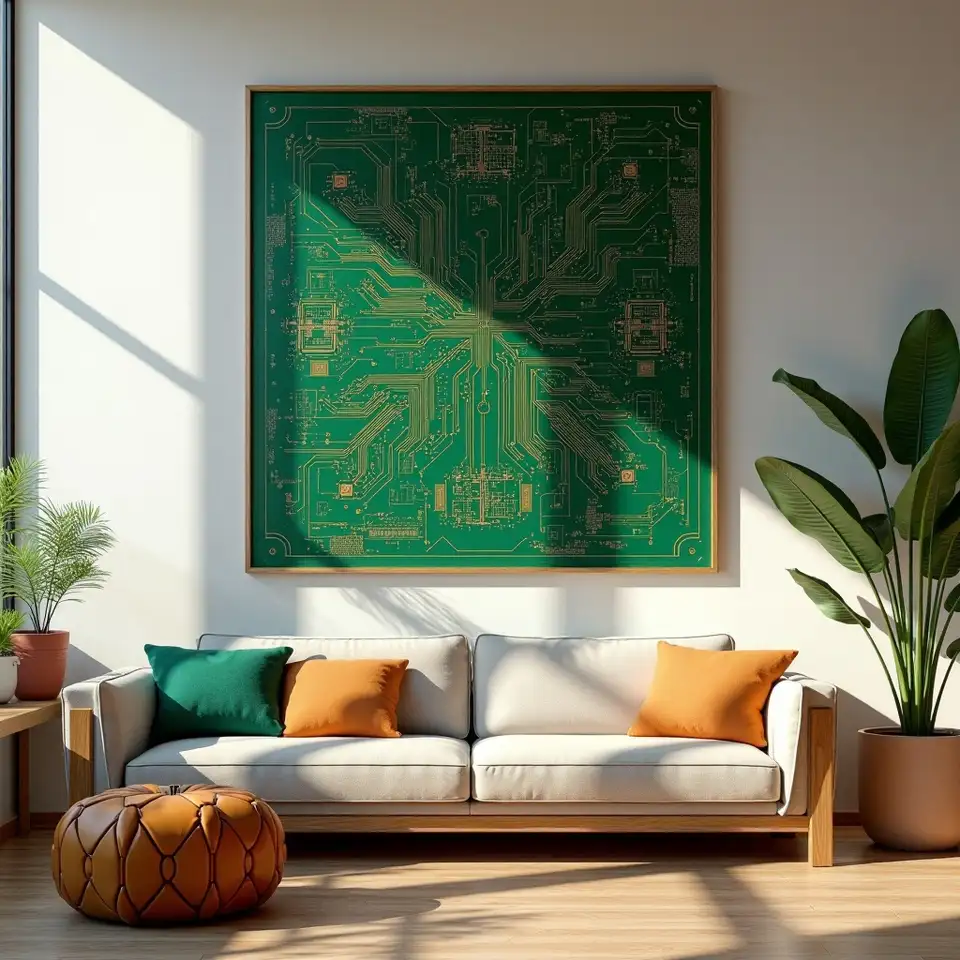
Multi-layer motherboard panel, framed in recycled timber
Community voices on craft and e-waste
What Making Circuit Board Art Does to the Way You See Waste
Community members describe how working with salvaged electronics changed their
relationship with discarded materials and their own creative practice
01
The assumption most people bring to circuit board art is that the boards
need to be cleaned up, simplified, made to look less like what they are.
That instinct produces mediocre work. The boards that make the most
striking finished pieces are the ones left to speak for themselves —
dense component arrays, mismatched trace colours, manufacturer markings
still visible under a clear seal. Working against the material is the
wrong approach. Learning to read what the board is already offering
takes time, but it changes everything about the compositional decisions
that follow.
-
Margaret Osei
Community Lead and Head Curator, Circuit Board Art
02
The first board I ever cut, I rushed the preparation stage because I
wanted to see the finished shape. The result cracked along a trace line
two days later. Going back to document why that happened — substrate
thickness, cut direction, tool speed — was more instructive than any
tutorial I had read to that point. The failure produced a guide that has
since helped several members avoid the same mistake. That is roughly how
the community's knowledge base works: the errors are as useful as
the successes, provided someone takes the time to record the conditions
that produced them.
- Tomás Brennan
- Tutorials Coordinator and Community Forum Moderator
03
Sourcing is where the environmental argument for circuit board art either holds or collapses. If a practitioner is purchasing new boards or supplementing salvaged material with fresh components to achieve a particular aesthetic, the work loses the thing that makes it genuinely distinct. The community's sourcing directory exists precisely to make the salvage-first approach practical rather than aspirational. Repair cafés, decommissioned-equipment suppliers, and community recycling drop-offs in most Australian cities provide a reliable and varied supply of boards without any purchase required. The constraint of working only with what is available there turns out to be creatively productive rather than limiting.
-
Priya Nair
- Sustainability Researcher and Board Sourcing Advisor
Lighting is the variable that most online gallery photographs cannot capture. A circuit board piece that reads as flat and uniform in a snapshot will reveal considerable depth under directional gallery light — the component shadows, the trace relief, the solder-point reflectivity all become visible in ways the camera compresses. This is why the community's annual showcase events matter alongside the online gallery. Seeing the work in person, under conditions that allow the material's physical properties to be read properly, changes the assessment of what circuit board art can do as a medium. The online archive is useful, but it is not the full picture.
- Daniel Kwok
Events Organiser and Community Gallery Coordinator
Community voices on craft and e-waste
These reflections come from members at different stages of practice — from
first-panel beginners to contributors with years of documented technique behind
them. The range of perspectives is intentional and representative of the
community's breadth.
Artist Spotlights
The stories and materials behind two notable pieces from the community archive
Renata Sousa
Mixed-media artist, Brisbane QLD
"Sourcing the boards for this piece took three visits to a community recycling drop-off before finding the right substrate density. The resin casting stage required two attempts — the first batch introduced bubbles along the component edges that the finished work could not absorb compositionally. The second pour, done at a lower ambient temperature, settled cleanly. The result is a piece that holds its surface interest at any viewing distance, which was the specific problem the work was trying to solve."
resin casting
mixed media
salvaged boards
+1
August 2025
David Hartley
Hobbyist craftmaker, Adelaide SA
"The clock project started as an experiment with a single decommissioned industrial controller board — a type with unusually high component density that had resisted every previous framing approach. Mounting it as a clock face resolved the compositional problem by giving the dense surface a functional centre point. The brass clock hands were sourced separately. The piece works better than anticipated, though the weight of the board required a more substantial wall mounting than the initial plan allowed for."
clock making
industrial board
wall mounting
+1
October 2025
Show Your Work
The gallery accepts submissions from community members at any skill level. Pieces are reviewed against the same curation criteria regardless of who submits them — sourcing documentation, technique notes, and a clear photograph under consistent lighting are the three things that make a submission ready for review. If the work was made from a salvaged board and the process is documented, it belongs here. The submission process is straightforward and the review turnaround is communicated clearly when the submission window opens.