Where old circuits find new purpose
The story behind a community that turns discarded electronics into considered, deliberate wall art and decorative craft pieces
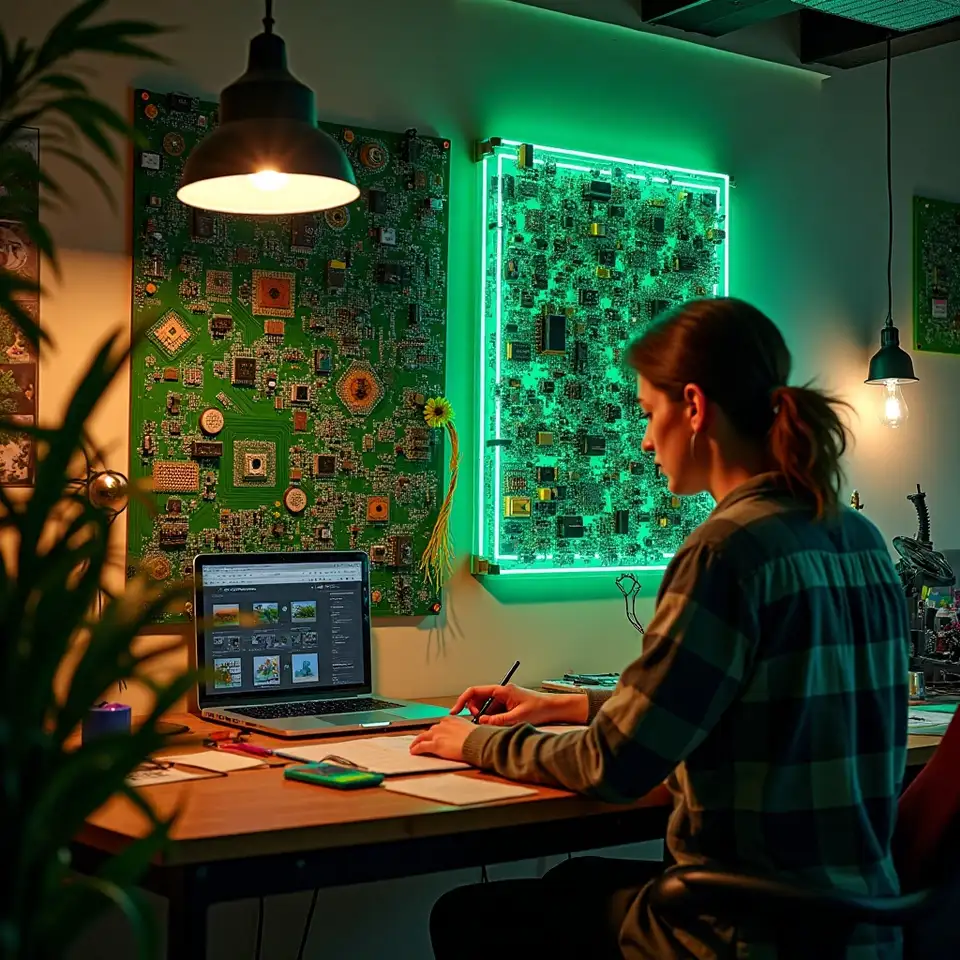
Most people toss a dead motherboard without a second thought. This community started by
asking what happens when you do not. Circuit boards carry geometry, colour, and texture
that few natural materials can match — and repurposing them keeps them out of landfill
while producing something genuinely worth hanging on a wall.
How this community came to exist
A shared curiosity about discarded electronics grew steadily into a practical, generous, and quietly obsessive hobby network
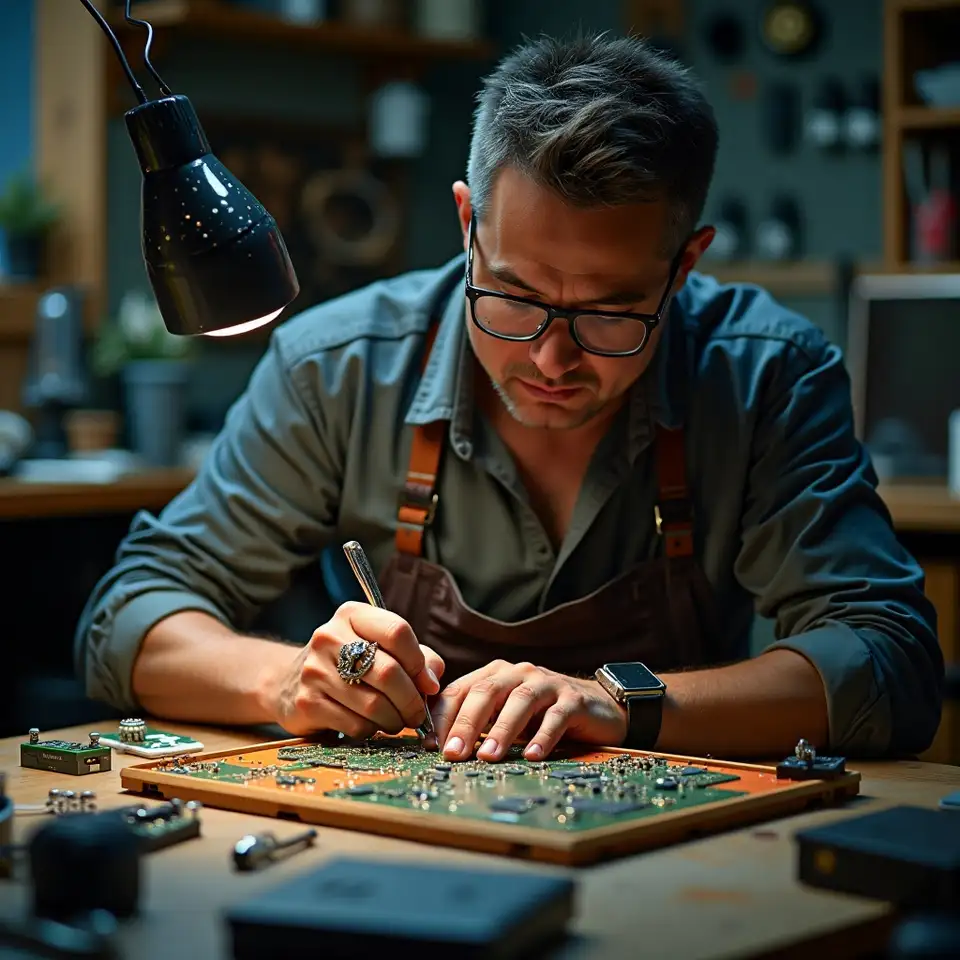
The wrong way to start is to buy new materials. The right way — the way this community discovered — is to look at the circuit boards already accumulating in drawers and recycling bins and see them as a raw medium. Copper traces, solder points, capacitor arrays, and resin-saturated fibreglass all behave predictably under a scroll saw or a jeweller's file. Once that was understood, sharing techniques became the natural next step, and the community followed from there.
Rooted in material curiosity and observation
The community began by cataloguing how different board types cut, layer, and respond to adhesives before any artwork was attempted.
Built on freely shared practical knowledge
Every technique developed here — from resin casting to framing — is documented openly so newcomers can start without expensive trial and error.
Sustained by a commitment to reducing e-waste
Redirecting end-of-life boards toward art rather than landfill remains the clearest measure of the community's ongoing contribution.
The principles that keep this community coherent and worth returning to
Community values in practice
These values are not aspirational statements — they describe how members of this community actually behave when they share a technique, source a board, or post a finished piece. Each one emerged from observed practice rather than committee deliberation, which makes them more durable than a mission statement written in advance.
Deliberate process
Rushing a cut or skipping a sealing step produces brittle results that do not
survive handling. The community documents slow, methodical approaches to each
stage — not because speed is wrong, but because understanding the process first
makes every subsequent shortcut an informed choice rather than an accidental
one.
Material honesty
Finished pieces are presented as salvaged-board work rather than disguised as
something produced from conventional art materials. The provenance of the
circuit board — its original manufacturer, approximate age, or device origin —
is considered part of the work's identity and worth noting where it can be
established.
Salvage first
Sourcing begins with what is already available — broken appliances,
decommissioned office equipment, community recycling drop-offs. Purchasing new
components to supplement a piece is discouraged unless the salvaged material
genuinely cannot support the intended design, and even then the community
prefers smaller additions over wholesale substitution.
Responsible finishing
Sealants, adhesives, and resins used to finish circuit board art carry their own
environmental considerations. The community maintains a running comparison of
low-VOC and water-based options that perform reliably on fibreglass and epoxy
board substrates, allowing members to make informed choices about the materials
added during finishing.
Skill-level transparency
Every tutorial and technique guide on this site is labelled clearly by required
skill and tool access. A member with a craft knife and basic hand tools should
not have to read three advanced guides before finding an entry point. The
community actively maintains beginner pathways and reviews them when new
techniques make earlier steps obsolete.
Open contribution
Techniques, sourcing tips, and finishing discoveries submitted by any community
member receive the same review and documentation treatment as those from
long-standing contributors. Seniority does not determine which knowledge gets
preserved. The quality and clarity of the contribution does, and that standard
applies consistently.
Plain documentation
Guides avoid jargon where plain language works equally well. Where technical
terms are necessary — soldermask, substrate, trace pitch — they are defined on
first use. The goal is that someone arriving from a general crafting background,
rather than an electronics one, can follow the documentation without needing a
separate glossary or prior technical reading.
Version control for techniques
As better approaches emerge, older guides are updated rather than left to contradict newer ones. Each technique page carries a last-reviewed date so members can judge currency at a glance. This discipline prevents the accumulation of outdated advice that plagues many hobby communities as their archives grow.
Moderation with context
Disputes about technique or sourcing are resolved by reviewing documented
evidence rather than deferring to whoever is most vocal. Moderators are expected
to explain decisions in writing, and those explanations are visible to the
relevant parties. The process is slow by design — it produces fewer reversals
and more considered outcomes than faster, opaque approaches.
Honest limitation notices
When a technique has not been tested across a broad range of board types, that caveat is stated in the documentation. The community does not present partial findings as universal conclusions. Members are expected to report back when documented techniques behave differently on boards not covered in the original testing notes.
Form follows material
Projects are encouraged to respond to what the salvaged board offers rather than forcing a predetermined design onto it. A board with dense surface-mount components suggests different compositional possibilities than one dominated by through-hole parts and open substrate. Working with those differences rather than against them tends to produce more coherent finished pieces.
Scale without hierarchy
Small framed pieces and large multi-panel installations receive equal
documentation attention. Neither is treated as a more serious or more legitimate
form of circuit board art. The community recognises that workspace, budget, and
available board stock vary considerably between members and that all scales of
work contribute meaningfully to the collective archive.
The people who keep this community running and useful
Four core contributors maintain the tutorials, moderate the forum, organise community events, and ensure the documentation stays current, accurate, and accessible to members at every level of experience

Margaret Osei — Community Lead and Head Curator
Community Lead and Head Curator for Circuit Board Art
Salvaged material art, circuit board surface treatment, and community
documentation standards
Academic background
Bachelor of Industrial Design, majoring in sustainable materials and product life cycles, University of New South Wales, Sydney, Australia
Margaret brought together the initial documentation framework that still underlies every technique guide on the site. Her background in industrial design gave her an immediate appreciation for how manufactured objects carry latent aesthetic properties — and a practical understanding of how materials behave under tools. She reviews all submitted guides before publication and coordinates the annual showcase events held across Australian cities.
Previous roles
Circular Craft Collective, Sydney
- Lead facilitator and materials research coordinator for upcycled craft
workshops
Green Assembly Studio, Melbourne
- Senior designer specialising in reclaimed electronics and decorative
object fabrication
Core skills
Circuit board surface analysis and preparation
Resin casting and low-VOC finishing
Community documentation and guide editing
+1
Working methods
Three-stage material assessment before any cutting or finishing begins
Peer-review documentation cycle for all new technique submissions
Certifications and training
Certificate IV in Visual Arts, TAFE New South Wales, completed
2019
Occupational health and safety for workshop environments, SafeWork NSW,
2021
Tomás Brennan — Tutorials Coordinator and Forum Moderator
Tutorials Coordinator and Community Forum Moderator
PCB composition analysis, scroll-saw cutting technique, and beginner pathway
development
Academic background
Diploma of Electronics Engineering Technology, with units in PCB design and component analysis, RMIT University, Melbourne, Victoria, Australia
Tomás joined after posting a detailed breakdown of his first circuit board panel piece, which became one of the most referenced guides in the archive. He now manages the tutorials pipeline, ensuring each submission meets the community's plain-language documentation standard before it goes live. He also moderates the forum with a preference for evidence-based discussion and a noticeable resistance to unsupported technique claims.
Previous roles
Maker Hub Brisbane
- Workshop facilitator and electronics upcycling programme coordinator
for community members
Freelance craft documentation
- Independent technical writer producing step-by-step guides for
hobbyist electronics repurposing projects
Core skills
Scroll-saw and jeweller's file technique
Beginner pathway design and review
Forum moderation and community dispute resolution
Working methods
Skill-level labelling system applied to all published tutorials and guides
Comparative tool-testing approach before recommending any cutting or
finishing equipment
Certifications and training
Safe use of power tools in community workshop settings, 2020
Technical writing for non-specialist audiences, Open Colleges
Australia, 2022

Priya Nair — Sustainability Researcher and Sourcing Advisor
Sustainability Researcher and Board Sourcing Advisor for the Community
E-waste sourcing networks, low-impact finishing materials, and lifecycle
analysis for salvaged boards
Academic background
Master of Environmental Science, specialising in electronic waste policy and material recovery systems, University of Queensland, Brisbane, Queensland, Australia
Priya's contribution to this community is the one most members benefit from without necessarily noticing it. She maintains the sourcing directory — a curated list of recycling drop-off points, decommissioned-equipment suppliers, and repair cafés across Australia where members can obtain boards without cost. She also reviews the environmental credentials of sealants and adhesives used in finishing, keeping the community's low-VOC recommendations current with available product ranges.
Previous roles
Queensland E-Waste Recovery Network
- Research analyst mapping regional electronic waste streams and
community reuse opportunities
Sustainable Craft Australia
- Materials advisor reviewing finishing products for hobbyist craft
communities with sustainability requirements
Core skills
E-waste sourcing and supplier network management
Low-VOC product evaluation and comparison
Environmental policy review and community guidance writing
+1
Working methods
Sourcing-first audit process applied before any project material is acquired
Annual product comparison review for sealants, adhesives, and resins
Certifications and training
Certificate in hazardous materials handling, Queensland Government,
2020
Life cycle assessment fundamentals, Australian Life Cycle Assessment
Society, 2023

Daniel Kwok — Events Organiser and Gallery Coordinator
Events Organiser and Community Gallery Coordinator
Exhibition design, circuit board piece framing and mounting, and community
showcase logistics
Academic background
Bachelor of Fine Arts, majoring in exhibition design and spatial curation for contemporary craft, Victorian College of the Arts, University of Melbourne, Victoria, Australia
Daniel manages the physical and digital sides of how this community presents its work to the wider public. He coordinates the annual showcase events, liaises with venues, and curates the online gallery with a consistent set of submission standards that keep the archive coherent over time. His background in exhibition design gives him a practical understanding of how circuit board pieces behave under different lighting conditions — knowledge that informs both the gallery curation criteria and the framing advice published in the tutorials.
Previous roles
Craft Victoria
- Exhibition coordinator managing contemporary craft showcases and
community artist submission processes
Independent gallery practice, Melbourne
- Freelance curator and installation designer for small-scale
contemporary and upcycled material exhibitions
Core skills
Exhibition design and spatial arrangement
Circuit board piece framing and mounting
Community event logistics and venue liaison
+1
Working methods
Submission review process using consistent lighting and scale criteria for
gallery acceptance
Two-stage venue assessment for community showcase events
Certifications and training
Certificate in arts administration and event management, Arts Centre
Melbourne, 2018
Manual handling and installation safety for gallery environments,
WorkSafe Victoria, 2022
Join a community that takes circuit board art seriously
The forum is open to anyone with a salvaged board and a question. The gallery accepts submissions from members at any skill level. The tutorials are written for people who want to understand what they are doing and why — not just follow steps. Whether the interest is in sourcing, cutting, finishing, or exhibiting, there is a documented pathway here that starts from where most people actually are, not where an expert assumes they should be.
A forum built on documented evidence
Technique discussions in the community forum are expected to reference tested approaches rather than personal preference. Moderators flag unsupported claims and invite contributors to share the conditions under which a technique was tested, making the forum a more reliable resource than most hobby discussion spaces.
A gallery with consistent submission standards
The online gallery applies the same curation criteria to every submission regardless of the contributor's standing in the community. Accepted pieces are documented with sourcing notes and technique references, creating an archive that is useful for research as well as appreciation.
Events held in Australian cities each year
Annual showcase events are organised in multiple Australian cities, giving members an opportunity to see circuit board art in person under gallery lighting conditions. Event details, venue information, and submission deadlines are published well in advance and updated on the events page as they are confirmed.
All techniques documented here reflect tested community experience. Results vary depending on board type, tools, and finishing materials used.